
How the Grainger County Court Calendar Works
Grainger County posts its main schedule as a downloadable PDF. It is a twelve-page month grid you save rather than a live event database. The official Grainger County court calendar page leads to a Download Manager. The package itself was created December 1, 2025. It was last updated March 16, 2026. Those dates describe only the file. They say nothing about the most recent action in any case.
Each day cell carries a category or a scheduled block. Expect many labels. They include Circuit Criminal, Circuit Civil, Sessions Criminal, Sessions Civil & Traffic, Juvenile, Child Support, Chancery, Grand Jury, Probate/Motions, Civil Jury, Criminal Jury, and Civil Non-Jury. Some blocks add a judge in parentheses. That name signals an assignment to the block. It is not a ruling.
The county calendar download screen is the page readers must use. Retrieve the file there.
This view confirms the document-first access method used for Grainger County court dates.
Grainger Court Schedule Weekly Rhythm
The calendar legend offers planning clues worth knowing. General Sessions arraignments generally appear every Tuesday and Thursday unless otherwise noted. Juvenile Court generally appears every Tuesday unless otherwise noted. Treat these as recurring blocks on the grid, not as promises that a particular case shows up each week.
Holiday cells, jury sessions, and special blocks break that rhythm. Use the weekly pattern to narrow a search. Then verify the exact setting through the docket or the clerk, and never read the pattern as a filing deadline or an order to appear.
Grainger County Court Date Lookups
A solid Grainger County court date lookup uses every channel available. Begin online. But expect to contact the right office, because the calendar lists no party names or case numbers. The Circuit Court Clerk keeps Circuit Court records. The same office holds General Sessions criminal and civil records, plus Juvenile Court records subject to access limits. The Clerk and Master handles Chancery matters. City court dates go through the municipal clerk instead.
- Open the current county calendar and save its publication or update date.
- Find the month and day, then record the court category exactly as printed.
- Compare the category with the relevant criminal or civil PDF on the Grainger County docket index.
- Call or visit the correct clerk when the documents conflict or omit the case.
- For mail, email, or fax, give the court, case number, date range, and the setting requested.
- Ask the custodian for a historical calendar or setting sheet through the public-record process when no current file answers the question.
Tennessee Case Finder offers subscription access for participating Circuit Court Clerk offices. Grainger participation is not confirmed. The Tennessee appellate search covers appeals, not routine trial settings. Federal settings run through CM/ECF or PACER. An attorney on the case can also confirm appearance instructions.
Confirm Grainger Court Schedule Locations
Official sources give two location references. The county courthouse listing gives one address. It puts Circuit, Criminal, and Chancery Courts at 8095 Rutledge Pike in Rutledge. The Circuit Court Clerk home page lists the clerk office separately. It sits at 270 Justice Center Drive, Suite 114. A courtroom and a records counter are not always the same place.
Before travel: Call the clerk and confirm the building, room, check-in process, and current Grainger County court schedule for that case.
This check matters when a PDF says only "court" or names a broad category. It also keeps you from the County Clerk, whose everyday work covers vehicle, license, marriage, title, business, and commission records rather than trial-court dockets.
Court Settings: What Each Field Means
One Grainger County court setting is one scheduled event. Read the calendar first, then turn to the case-level docket report for details. Criminal PDFs can show hearing dates and times. Types include Preliminary Hearing, Arraignment, or Review Hearing. Civil PDFs can show a setting date and time, judge, court, and case subtype.
| Date | The planned calendar day. Confirm it against the latest docket version. |
|---|---|
| Time | The listed setting time, which may be part of a broader docket call. |
| Courtroom | The place assigned for the event. The public calendar may not supply a room. |
| Judge | The judge assigned to a block or setting, not proof of a ruling. |
| Setting Type | The event label, such as arraignment, preliminary hearing, review, jury, or motions. |
A setting proves none of the things people assume. It does not show attendance, a hearing, a plea, judgment, or disposition. When an outcome matters, pull the file or ask the clerk for the later docket entry.
Grainger Court Calendar Category Terms
The month grid packs many kinds of court work into short labels. Read them as routing terms. Some mark a stage, others name a court or a group of cases. The public materials never define TNROCS. Ask the clerk rather than guessing.
- Arraignment
- A criminal stage at which the accused is advised of the charge and enters or is expected to enter a plea.
- Preliminary hearing
- An early felony-stage hearing used to decide whether the prosecution may proceed.
- Grand Jury
- A schedule category that does not authorize access to confidential grand-jury material.
- Probate/Motions
- A block for probate work or motions; the label alone reveals no result.
- Cont’d
- A continuation mark showing the matter was carried to another setting or appears as continued.
Juvenile and Child Support labels do not open the underlying files. Tennessee law can keep case documents closed even while the schedule shows the broad block.
When a Court Date Moves
A continuance moves a setting to another date. Settlements, plea changes, emergencies, cancellations, courtroom changes, and judicial scheduling can all alter the published plan too. The criminal report may carry a continuation marker. Later PDF versions sometimes repeat a continued matter, so two lines do not always mean two cases.
Check the Download Manager date and any report-generated timestamp. Then compare the case entry with the month grid. If the sources disagree, call the clerk. The Grainger local-rules index links court-specific rules, and Tennessee Supreme Court Rule 18 governs the place of local rules in trial practice. For Circuit Civil settings, the calendar itself points readers to those local rules.
An older PDF does not control just because you saved it first. Keep it as a dated snapshot, then get current instructions from the court.
Grainger Court Schedule Source Checks
The clerk keeps a second official route to the schedule. The alternate Grainger County calendar page offers another way to reach the same schedule package.
A matching screen lets a reader check that a file really came from the county court source. That step matters. Broad schedules deserve confirmation before anyone leans on them. Settings can also move under local rules. The Tennessee Supreme Court Rule 18 page lays out the statewide local-rules framework for how and when that happens.
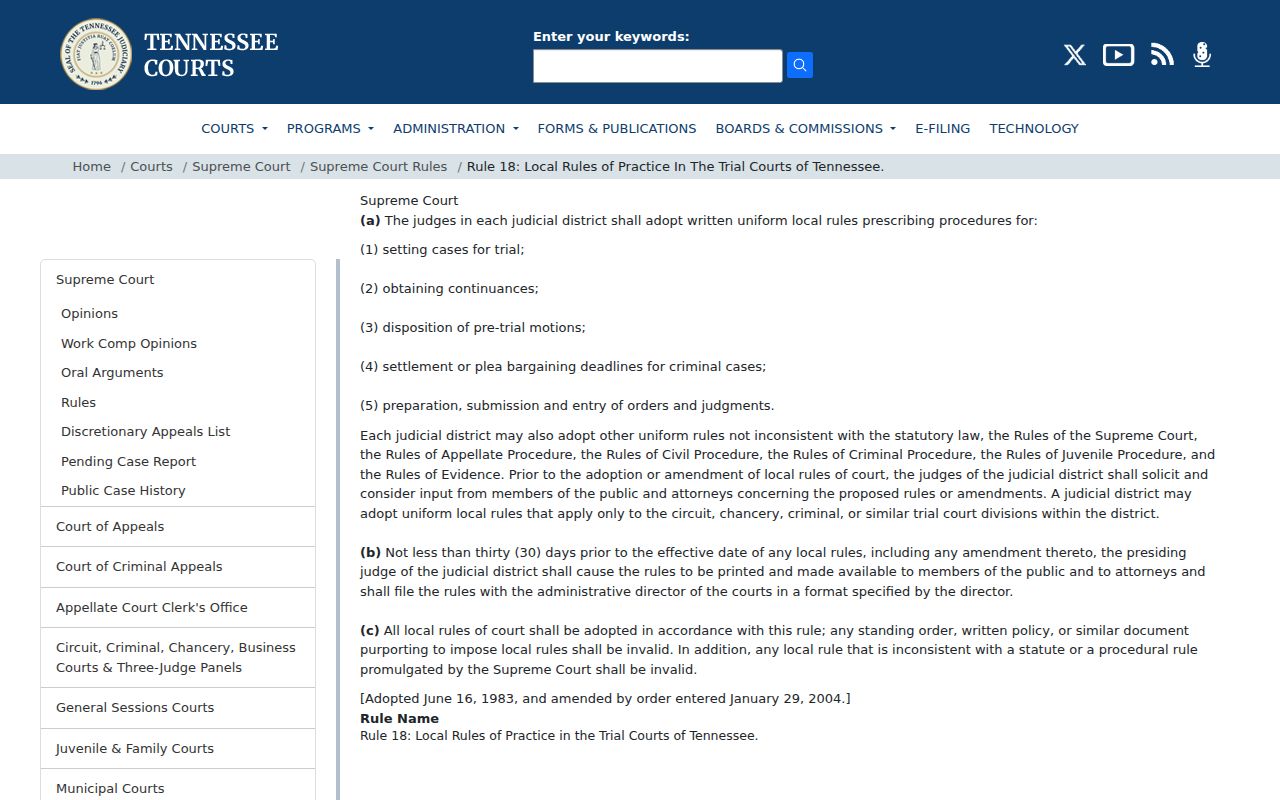
That rule source belongs beside the Grainger calendar and each court's own local rules. It replaces neither.
Missed Settings and What Comes Next
Miss a Grainger County court date? Act fast. Call the clerk for the court named on the docket and ask whether a new setting, a failure-to-appear entry, or some other action has landed on the case. If you have a lawyer, call that office too. The month grid alone will not settle it, since it carries no case-specific outcome field.
Missed a setting? A missed criminal or traffic appearance may lead to a failure-to-appear entry, warrant, bond action, or other consequence.
Ask the clerk for the current setting and docket status, and seek advice from a Tennessee-licensed attorney about the safest next step.
Never just show up at an unconfirmed time. Confirm the courtroom as well as the date. A municipal case runs through Bean Station, Blaine, or Rutledge, so contact those city courts directly rather than assuming the county calendar covers them.
Grainger Court Calendar Access Boundaries
The calendar is public schedule information. The underlying case may still be restricted. Tennessee Supreme Court Rule 34 presumes public access to court records. But it honors exceptions set by law, court order, and other rules. Juvenile, adoption, protected-address, medical, financial, grand-jury, and sealed material can be withheld or redacted.
The calendar lists no party names at all. So a name missing from it proves very little. The absence may point to the wrong court. It could be a municipal setting, an archive, a reset, restricted access, or the calendar's category-level design. When the full file cannot be released, ask separately for the public docket sheet or public orders.
Older schedules may take a request to the clerk. That request can go by phone, in person, mail, fax, or email. State guidance sketches a seven-business-day response framework: produce the records, deny in writing, or estimate the time and cost. That framework promises a response, not completion, within seven days.
Note: Verify any public setting with the responsible clerk. Access to the calendar and permission to inspect the case file are two different questions.